
By CESAR JOLITO III
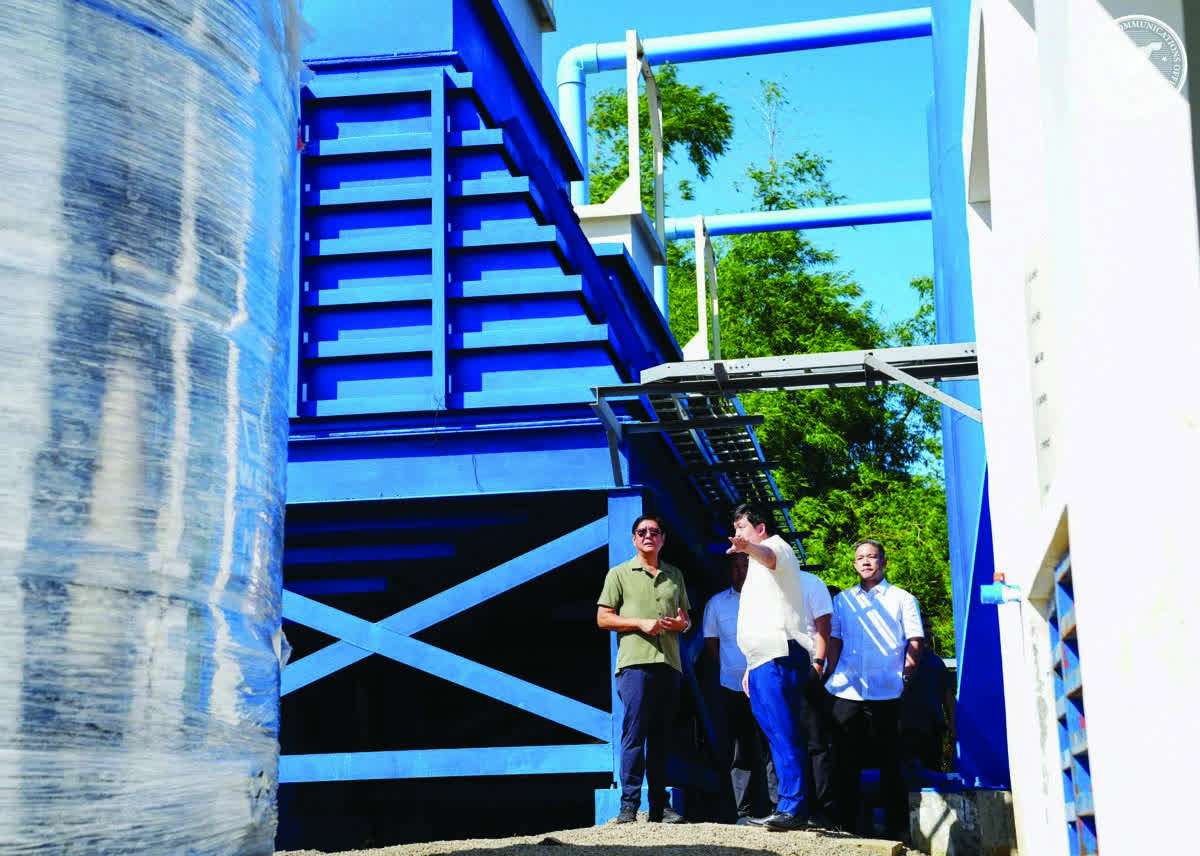
President Ferdinand Marcos, Jr. said the newly inaugurated Sum-ag Water Treatment Plant will ensure a reliable and sustainable water supply for Bacolod City, with the facility capable of delivering up to 75 million liters of potable water per day, benefiting about 100,000 households or roughly 500,000 residents through the Bacolod City Water District.
Speaking after inspecting the facility at Barangay Salvacion in Negros Occidental’s Murcia town, Marcos said the project is a critical investment in public health, economic activity and long-term urban resilience as the city moves away from dependence on finite and unsustainable groundwater sources.
The Sum-ag Water Treatment Plant is part of the Bacolod-Murcia Bulk Water Supply System implemented by Bacolod Bulk Water Inc. (BBWI), a subsidiary of Tubig Pilipinas Group Inc.
BBWI is part of the Tubig Pilipinas Group, a Philippine-based water infrastructure platform established in 2014 to deliver sustainable water and sanitation solutions outside Metro Manila.
The P1.5-billion project was financed through shareholder equity, including foreign direct investment from Climate Fund Managers, and long-term loans.
The facility is among the largest water treatment plants in the Negros Island Region and forms part of a multiphase bulk water project that currently supplies around 40 million liters per day (MLD), covering nearly 40 percent of Bacolod’s water requirements, with infrastructure designed for future expansion.
Tubig Pilipinas is owned by Quadwater and Pure Water, with 15 percent foreign direct investment from Climate Fund Managers — a Dutch-European Union fund supported by the Netherlands and the European Union.
Project phases
The first phase, the Ngalan Water Treatment Plant in Bacolod’s Barangay Granada, was commissioned in October 2017, initially supplying 10 MLD at P8.85 per cubic meter.
Today, the plant supplies up to 24 MLD, remaining one of the lowest-cost bulk water projects in the Philippines despite inflationary pressures.
The second phase, Sum-ag Water Treatment Plant, was completed in January 2025, with the 12.5-kilometer Murcia-Bacolod transmission pipeline completed in March 2025. It currently delivers 15 MLD of potable water.
Lastly, Phase 3 — Caliban River Intake in Murcia’s Barangay Abo-abo, completed in October 2025, adds 20 MLD of capacity.
The inauguration event formally covers both the Sum-ag plant and the Caliban Intake Facility.
The combined system currently supplies at least 40 MLD, equivalent to 40 percent of Bacolod City’s water requirements, with infrastructure designed to scale to 60 MLD.
BBWI is currently undertaking Stage 4 expansion, further increasing abstraction from the Caliban River and strengthening northern system redundancy.
Construction partners included Quadcore Construction and TGV Builders Inc. for civil works and pipelaying; Mactan Rock for water infrastructure; and Watermatic International for water treatment, automation and control systems.
Watermatic International, based in Israel, delivers fully automated, energy-efficient and redundant systems across intake, treatment and conveyance.
The Sum-ag Water Treatment Plant is accredited by the Board of Investments under the Department of Trade and Industry.
The Bacolod-Murcia Bulk Water System is strategically important for reducing reliance on finite groundwater, improving public health, enhancing climate resilience, and supporting economic growth through a reliable and affordable water supply.
At full scale, the system can serve over 750,000 people, covering the long-term needs of Bacolod and Murcia.
Bacolod’s water future
Bacolod City Representative Alfredo Abelardo Benitez said the inauguration marks a major step toward securing Bacolod’s long-term water supply and protecting the city from recurring shortages, particularly during dry months.
“Today is an important day for Bacolod because we are inaugurating infrastructure that supports one of life’s most basic needs — water,” Benitez said, stressing that the project is about delivering water that flows into homes, schools, hospitals, and businesses.
Benitez noted that Bacolod remains heavily dependent on deep wells, which he described as unsustainable due to over-extraction, rising operational costs and vulnerability during peak demand.
“Our plan is to gradually retire these deep wells as primary sources and convert them into strategic water reserves,” he said, adding that this approach will stabilize supply, protect groundwater, and keep water affordable for consumers.
He said the Sum-ag and Caliban facilities represent one of the largest water supply investments in the Visayas, with a combined capacity of around 50 MLD, capable of supplying up to half of Bacolod’s current water demand.
“Water security today is no longer just about infrastructure. It is about resilience in the face of climate change, population growth and urban expansion,” Benitez said.
“Because the future does not wait for us to react. We must prepare for it — deliberately,” he added./CJ, WDJ