
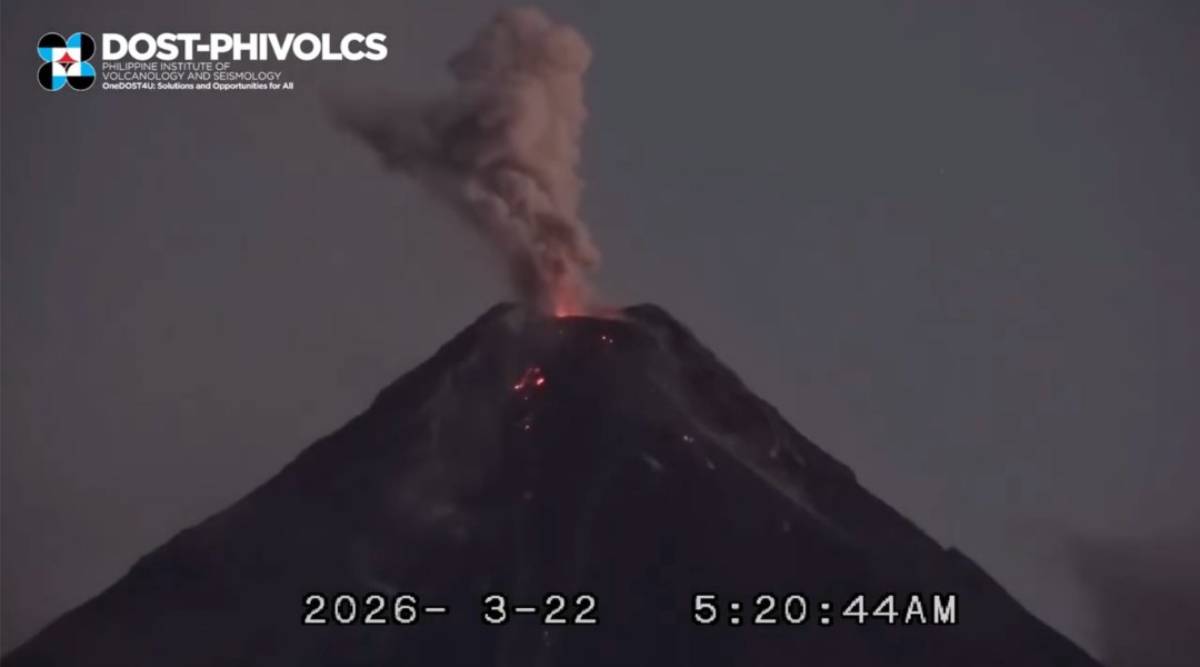
The alert status over Kanlaon Volcano may be raised to Alert Level 3 should it erupt again in the next few days, according to the Philippine Institute of Volcanology and Seismology (Phivolcs).
While Alert Level 2 remains in effect, Phivolcs warned that the March 15 eruption is already the third within a month and could signal magmatic intrusion that may lead to a fully magmatic eruption.
“There is a higher possibility of another moderately explosive eruption,” revealed Ma. Antonia Bornas, chief of Phivolcs’ Volcano Monitoring and Eruption Prediction Division, during the pre-disaster risk assessment meeting of the Regional Disaster Risk Reduction and Management Council.
“And when eruptions are in close succession, we really need to raise Alert Level 3,” she underscored.
In its eruption bulletin, Phivolcs said that fully magmatic eruptions could produce dangerous volcanic hazards within the volcano’s lava and pyroclastic density currents (PDC) hazard zones.
With this, it urged local government units within the PDC hazard zone, especially those within the six-kilometer extended danger zone, to prepare for possible evacuations should the unrest worsen, and Alert Level 3 is declared.
According to the Office of Civil Defense in the Negros Island Region, more than 14,700 families or 73,000 individuals will be affected when an alert level step-up is ordered.
Meanwhile, under Alert Level 2, Phivolcs advises the public to monitor levels of sulfur dioxide (SO2) in the daily bulletins the agency posts on its official social media platforms, since a decrease in emission was observed to precede explosive eruptions.
“SO2 has been continuously degassed at an average rate of 2,755 tons per day since June 3, 2024, when eruptive unrest began, and at an average rate of 1,401 tons per day since January 1, 2026,” the agency explained, noting that emissions averaged 1,085 tons per day prior the March 15 eruption, but a decrease to just 589 tons per day was recorded on March 14.
It further explained that the recurring blockage or sealing of volcanic gas pathways of a magma source and the resulting pressurization generate eruptions — a repeating eruption mechanism since its June 2024 explosive activity. (PIA Negros Occidental)